.webp)


.png)


The Unchosen A.37
Rashida Akter(ラシダ・アクテル)
(English translation follows below)
私は英語が全然読めないわけではない。
学校で習った。
MADE IN BANGLADESH はもちろん読めるし、COTTON とか SIZE とか WASH も分かる。
ブランドの名前は読めても、何の意味なのか分からないことが多い。発音が難しい名前もある。
前にスルタナと二人で適当に読んでいたら、ラインリーダーに笑われた。
別に正しく読めなくても仕事には困らない。
必要なのは、どのラベルを、どこに、どういう向きで縫うか分かることだから。
今の工場に入った最初の週は、縫うのが遅かった。
ラベルを真ん中に置いたつもりでも少し右へ寄っていたり、縫い目が斜めになったりした。検品から戻ってくると、糸をほどいてもう一度縫わなければならない。
あれが一番嫌だった。
今は、ほとんど一回でできる。
布を持ったときに、ラベルが少しずれているのが分かる。縫い終わったあとに見なくても、変なところを通ったときは指で分かることもある。
そういうときは少し嬉しい。
最初はできなかったことだから。
自分で仕事が上手いと言うのは変だけど、前よりは上手くなったと思う。
同じ服を何百枚も見るので、休みの日に市場で服を見るときも、つい内側を見てしまう。
縫い目がまっすぐか、糸が残っていないか、ラベルが曲がっていないか。
友達には、仕事みたいだからやめなよ、と言われる。
たしかにそうだと思う。
でも、きれいに縫ってあると見てしまう。
自分がやったものではないのに、ちゃんとしていると少し気持ちがいい。
逆にラベルが大きく曲がっていると、直したくなる。
工場では、ときどきその服がどの国へ行くのか聞くことがある。
日本だったり、ドイツだったりする。
日本がどこにあるかは知っている。学校で地図も見た。
でも、日本のどんな店にこの服が並ぶのかは知らない。
寒いところなのか、暑いところなのかもよく知らない。
たまに、誰が着るんだろうと思う。
私と同じくらいの年の女の子かもしれないし、もっと年上かもしれない。
その人がラベルを見るかどうかは分からない。
私は服を買ったら見るけれど、それは仕事をするようになってからだ。
朝は5時半くらいに起きる。
ファジュルをして、ご飯を食べて、家を出る。
仕事の日に全部の礼拝をきちんと時間どおりにできているかと聞かれたら、できていない日もある。
そういうことは、ここにはあまり立派に書かない方がいいと思う。
ラマダンも最初の数日はきつい。
午後になると喉が乾くし、夕方には頭が重くなることもある。
それでも仕事をしている人は周りにもたくさんいる。
給料が入ったら、実家へお金を送る。
だいたい3,000タカ。
母から電話が来ると、父が後ろから何か言っている。
二人同時に話すので、よく聞こえない。
私はもう少しいい携帯が欲しいと思っている。
写真がきれいに撮れるやつがいい。
まだ買っていない。
工場では毎日たくさんのラベルを見る。
自分の名前を服に書きたいと思ったことはない。
そんなことをしたら不良品になる。
それより、自分が縫ったラベルが曲がっていない方がいい。
誰が縫ったかなんて、着る人には分からないと思う。
私も、それでいい。
でも、もし自分が縫った服をどこかで見ることがあったら、たぶん最初にラベルを見る。
ちゃんとまっすぐ付いているか、確かめると思う。
|1|
朝6時を過ぎた頃、ラシダ・アクテルはミルプールの借家を出る。
19歳。部屋は同じ縫製工場に勤める三人の女性と共有している。朝食は前夜に作ったダルと米で、起きてから家を出るまでにファジュルの礼拝を済ませる。
工場までは一台の乗り物では行けない。
細い路地からリキシャで大通りへ出て、そこからサバール方面へ向かうバスか乗合車に乗る。渋滞がひどい日は、工場の門へ着くまで一時間半近くかかる。
ラシダが14歳まで暮らしていたガファルガオンでは、父親が米とジュートを作っていた。自分たちの小さな土地に加えて農地を借りていたが、洪水が続いた年に収穫が落ち、借金が増えた。ラシダは8年生の途中で学校を辞めた。
現在の工場へ入ったのは18歳になってからである。
工場の入口でカードをかざし、更衣スペースへ向かう。フロアへ上がる頃には、複数の縫製ラインがすでに動き始めている。
|2|
ラシダはラインの終盤近くで、衣服の内側へラベルを縫い付けている。
この日の商品は薄手のトップスで、背中側の襟元へブランドラベルとサイズ表示を取り付ける。裁断された布から一着を作り上げるわけではない。ラシダのところへ来る時点で、袖も身頃もほぼ形になっている。
彼女が担当するのは、その中の一工程だけだ。
ラベルを置き、位置を合わせ、ミシンを踏む。完成したら次の一着を取る。
最初の頃は、縫い目が斜めになったり、ラベルの中心が数ミリずれたりして検品から戻された。今は布を持った時点で、だいたいの位置を合わせられる。
工場では数字が頻繁に掲示される。ラインごとの生産数、不良率、その日の目標。商品が変われば作業時間も変わるため、ラシダが一日に扱う枚数も一定ではないが、多い日には数百着に同じ種類のラベルを付ける。
彼女は英語をまったく読めないわけではない。
学校で習ったので、アルファベットも基本的な単語も分かる。SIZE、COTTON、MADE IN BANGLADESHなどは見慣れている。
ブランド名も文字としては読めることがある。ただ、何を意味する名前なのかは知らないことが多い。
昼休みになるとミシンの音が止まり、ラシダは同僚と食堂へ行く。ご飯、ダル、野菜が載った皿を受け取る。
午後になると肩と腰が重くなる。
縫製工場で働く女性たちには、長時間同じ姿勢で仕事をすることによる腰痛や関節痛、目の疲れ、布埃による呼吸器症状などが報告されている。ラシダも仕事の終わりには背中を伸ばす癖がついた。
|3|
出荷が近づくと、ラインリーダーが残業の予定を知らせる。
その日は夕方で終わるはずだった仕事が二時間延びた。
残業そのものは珍しくない。ラシダは携帯電話のカレンダーに、その日何時間残ったかを記録している。給料日になると、給与明細に記載された残業時間と照らし合わせるためだ。
バングラデシュの労働法では、通常労働を超えた時間には割増賃金が定められている。最低月額賃金は2023年末にTk12,500へ引き上げられ、その後は年次昇給率も引き上げられた。それでも物価上昇を背景に、賃金をめぐる労働争議は繰り返されてきた。
ラシダがこうした制度を詳しく説明することはない。
給料日になると見るのは、手取り額と残業時間、それから今月いくら実家へ送れるかである。
通常はTk3,000ほどをbKashで送る。
母親からは、届いたという短いメッセージが返ってくる。
|4|
バングラデシュの縫製産業は約400万人を雇用する巨大な輸出産業で、女性はその半数を超える。
2013年のRana Plaza崩壊後、輸出向け工場では建物、消防、電気設備を中心に大規模な検査と改修が行われた。現在の工場を、かつての危険な建物とそのまま同一視することはできない。
一方で、賃金、長時間労働、反復作業による身体負担、職場の空気や暑さなど、建物の強度とは別の問題は残っている。
ラシダの工場で完成した服には、最終検品のあと複数の表示が付けられる。
ブランド名。
サイズ。
素材。
洗濯方法。
製造国。
そこにはかなり多くの情報が書かれている。
ラシダは、その中のいくつかを毎日読んでいる。
仕事を始めて一年ほど経った今では、自分が担当したラベルが少し傾いていれば、離れたところからでも気づくことがある。
勤務を終えたラシダは、バスに乗ってミルプールへ戻る。
翌朝になれば、別の束の衣服が同じ位置まで流れてくる。
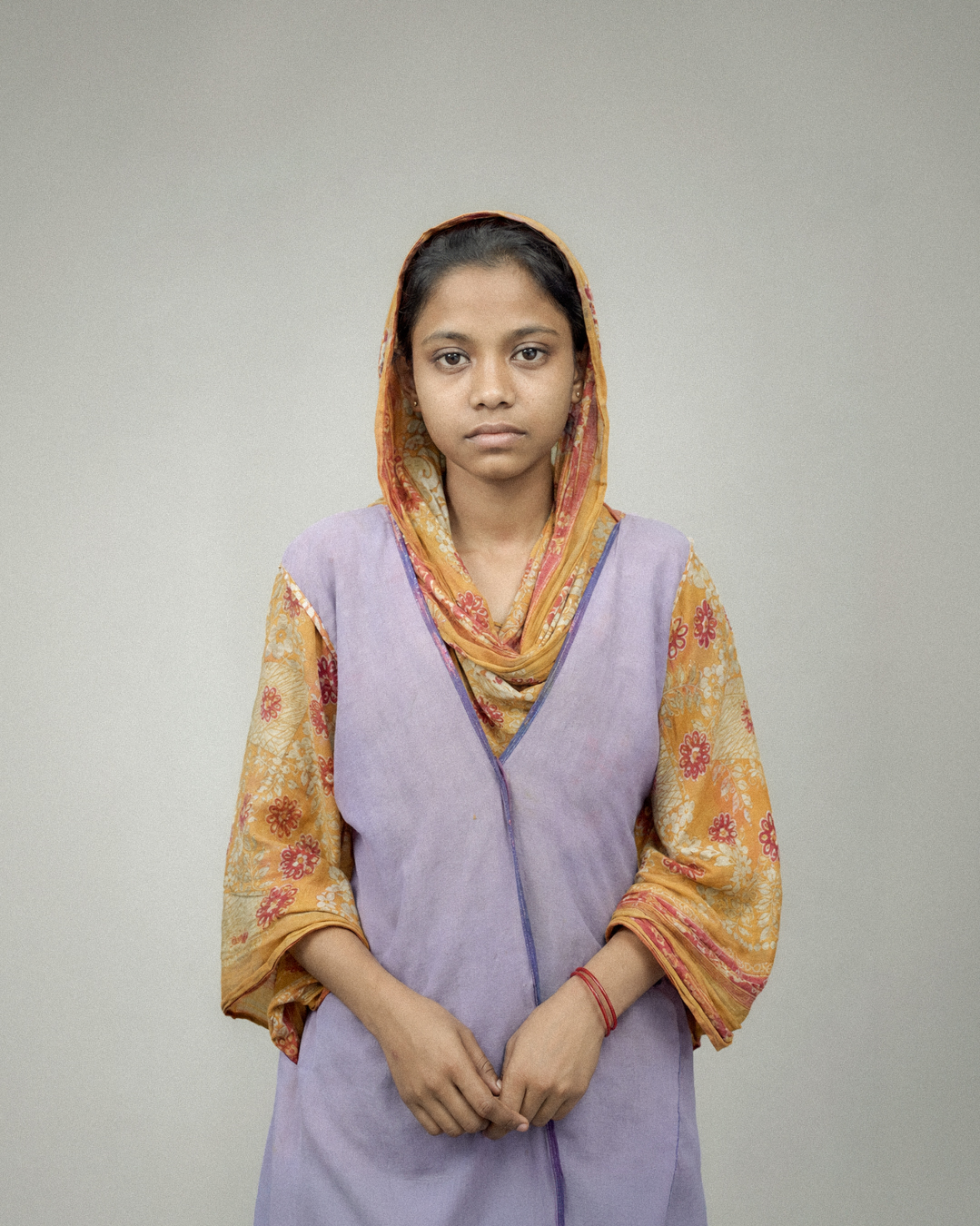
English
I’m not completely unable to read English.
I learned it at school.
Of course I can read MADE IN BANGLADESH, and I know words like COTTON, SIZE, and WASH.
Sometimes I can read the brand name without knowing what it means. Some names are difficult to pronounce.
Once Sultana and I were making up our own pronunciations and the line leader laughed at us.
It doesn’t really matter if I pronounce them correctly.
For the job, what matters is knowing which label goes where, and which way it should face.
During my first week at this factory, I was slow at sewing them.
I would think a label was centred when it was slightly to the right, or the stitching would run crooked. If inspection sent it back, I had to unpick the thread and sew it again.
I hated that most.
Now I usually get it right the first time.
When I hold the fabric, I can tell if the label is slightly out of position. Sometimes I can feel through my fingers when the stitching has gone somewhere it shouldn’t, even before I look at it.
That makes me a little happy.
I couldn’t do that when I started.
It feels strange to say that I’m good at my job, but I think I’m better than I used to be.
Because I see hundreds of garments at work, even on my days off I find myself checking the inside of clothes at the market.
Whether the stitching is straight. Whether loose threads have been left behind. Whether the label is crooked.
My friends tell me to stop because it makes shopping feel like work.
They’re probably right.
But when something is sewn neatly, I still look.
Even when I didn’t make it, there is something satisfying about seeing it done properly.
If the label is badly crooked, I want to fix it.
At the factory, sometimes we hear which country an order is going to.
Japan. Germany.
I know where Japan is. We had maps at school.
What I don’t know is what kind of shop these clothes will be sold in.
I don’t really know whether the place they are going is cold or hot either.
Sometimes I wonder who will wear them.
Maybe a girl around my age. Maybe someone much older.
I don’t know whether that person will ever look at the label.
I look at labels when I buy clothes, but I only started doing that after I began this job.
I wake up at around five-thirty.
I pray Fajr, eat, and leave for work.
If you ask whether I manage every prayer properly and at the right time on a workday, there are days when I don’t.
I don’t think I should make myself sound more devout here than I really am.
The first few days of Ramadan are difficult too.
By afternoon I’m thirsty, and sometimes by evening my head feels heavy.
There are plenty of other people around me working the same way.
When I get paid, I send money home.
Usually around three thousand taka.
My mother calls afterward, and my father says things in the background.
They both talk at once, so I can’t hear either of them properly.
I would like a better phone.
One with a nicer camera.
I haven’t bought one yet.
I see a lot of labels every day.
I have never wanted to put my own name on a garment.
That would make it defective.
I would rather the label I sewed on be straight.
The person wearing it will probably never know who attached it.
That is fine with me.
But if I ever happened to see one of the garments I worked on somewhere, I think the first thing I would do is check the label.
I would want to see whether it was still straight.
|1|
Shortly after six in the morning, Rashida Akter leaves the rented room she shares in Mirpur.
She is nineteen. She shares the room with three women who work at the same garment factory. Breakfast is rice and dal left over from the night before, and she performs Fajr prayer before leaving for work.
Getting to the factory requires more than one form of transport.
She takes a rickshaw from the narrow lanes to the main road, then boards a bus or shared vehicle heading toward Savar. On days when traffic is especially bad, it can take close to an hour and a half to reach the factory gate.
Until she was fourteen, Rashida lived in Gafargaon, where her father grew rice and jute. The family cultivated a small plot of their own and rented additional farmland, but after successive floods damaged the harvest, their debts increased. Rashida left school partway through the eighth grade.
She began working at her current factory after turning eighteen.
At the entrance, she taps her employee card and heads toward the changing area. By the time she reaches the production floor, several sewing lines are already running.
|2|
Rashida works near the end of a sewing line, attaching labels to the inside of garments.
That day, the product is a lightweight top. She attaches the brand label and size label at the back of the neckline. She does not make an entire garment from cut fabric. By the time a piece reaches her station, the sleeves and body have already largely taken shape.
Her responsibility is one operation within that process.
She positions the label, aligns it, presses the pedal, and guides the fabric through the machine. When one piece is finished, she reaches for the next.
At first, garments were sometimes returned from inspection because her stitching ran crooked or the centre of the label was a few millimetres out of position. Now she can usually place it correctly as soon as she takes the fabric in her hands.
Numbers are displayed throughout the factory: output by line, defect rates, daily targets. Because the time required changes with the garment, the number Rashida handles in a day is not fixed, but on busy days she may attach the same type of label to several hundred pieces.
She is not unable to read English.
She studied it at school and knows the alphabet and basic words. SIZE, COTTON, and MADE IN BANGLADESH are familiar to her.
Sometimes she can sound out a brand name as written, although she often has no idea what the name itself means.
When the lunch break begins, the sewing machines stop and Rashida goes to the canteen with her coworkers. She receives a plate of rice, dal, and vegetables.
By afternoon, her shoulders and lower back begin to feel heavy.
Women working in garment factories have reported back and joint pain from long periods in the same position, as well as eye strain and respiratory symptoms associated with textile dust. Rashida has developed a habit of stretching her back at the end of the working day.
|3|
As a shipment deadline approaches, the line leader announces the overtime schedule.
That day, work that was supposed to end in the late afternoon continues for another two hours.
Overtime itself is not unusual. Rashida records the extra hours in the calendar on her phone so that, on payday, she can compare them with the overtime listed on her pay slip.
Under Bangladeshi labour law, work beyond normal hours is subject to overtime pay. The minimum monthly wage for garment workers was raised to Tk12,500 at the end of 2023, and the annual increment rate was subsequently increased. Even so, labour disputes over wages have continued against a background of rising living costs.
Rashida does not explain these rules in detail.
On payday, what she looks at is her take-home pay, the number of overtime hours recorded, and how much she can send home that month.
Usually, she sends around Tk3,000 through bKash.
Her mother replies with a short message saying that the money has arrived.
|4|
Bangladesh’s garment industry is a vast export sector employing roughly four million people, with women making up more than half of the workforce.
After the collapse of Rana Plaza in 2013, export-oriented factories underwent extensive inspections and improvements focusing on structural, fire, and electrical safety. Factories today cannot simply be treated as identical to the unsafe buildings that came before those reforms.
Other problems remain, however, including wages, long working hours, the physical strain of repetitive work, workplace air quality, and heat.
Garments completed in Rashida’s factory receive several kinds of information after final inspection.
The brand name, size, fibre content, washing instructions, and country of manufacture are all recorded.
There is a considerable amount of information on the labels.
Rashida reads some of it every day.
After about a year at the factory, she can sometimes notice from a distance when a label like the ones she attaches has been sewn slightly crooked.
When her shift ends, Rashida takes the bus back toward Mirpur.
The following morning, another bundle of garments will reach the same position on the line.
日本語本作に登場する人物・語りは、実在の個人に基づいたものではありません。設定・描写にあたっては、人物の文化背景、言語、歴史、現在の社会状況について文献・記録・当事者の語り等を調査し、それらをもとに構成・再構成し、物語として描いています。ただし、たとえ綿密なリサーチをもとにしていても、"他者の声を仮構すること"には構造的な危うさがあると私は考えています。この作品は、その危うさごと提出するための試みです。
EnglishThe characters and narratives presented here are not based on any real individuals.The setting and depiction are constructed and restructured through research into cultural backgrounds, languages, histories, and contemporary conditions—including archival sources and first-person accounts—and are rendered here as a narrative.However, even when grounded in careful research, I believe that fictionalizing the voice of another carries inherent structural risk.This piece is an attempt to present that risk itself—openly and with accountability.